
Estate Landscaping in South Jersey: Designing Properties That Make a Statement
There is a clear difference between landscaping a property and designing an estate. Standard residential work focuses on individual elements: a patio here, a row of shrubs there, a lawn that stays green through summer. Estate landscaping operates at an entirely different scale. It treats the full property, every acre, every sightline, every transition from built structure to open ground, as a single cohesive composition. For owners of large properties across Gloucester County and South Jersey, this approach transforms land into something that commands attention the moment someone turns into the driveway.
The distinction comes down to three factors: scale, detail, and coordination. A half-acre lot might need a planting bed and a walkway. A two-acre estate needs a master plan that accounts for grading across hundreds of feet of elevation change, specimen trees positioned to frame architectural features from multiple vantage points, hardscape materials that unify the front entrance with a rear terrace a hundred yards away, and drainage systems engineered to handle stormwater runoff across the entire property. Every decision affects every other decision. That level of integration is what separates premium landscape installation from routine residential work.

Full-Property Master Planning
Estate landscaping begins long before the first plant goes into the ground. A comprehensive landscape design for a large property starts with a site analysis that maps existing conditions: soil composition, natural drainage patterns, sun and shade exposure throughout the day, prevailing wind direction, existing trees worth preserving, and the architectural style of the home. In South Jersey's Zone 7a climate, we also evaluate microclimates across the property, because a north-facing slope and a south-facing terrace on the same lot can behave like two different growing zones.
The master plan then organizes the property into distinct zones, each with a defined purpose. A formal entry sequence from the street to the front door. Foundation plantings that frame the home's architecture. Transitional pathways connecting the house to outdoor living areas. Private garden rooms screened from neighbors. Open lawn areas for recreation. Naturalized perimeters that blend into surrounding woodland or agricultural land. Each zone has its own character, but the materials, plant palette, and design language remain consistent throughout, creating a property that reads as one intentional composition rather than a collection of disconnected projects.
For properties in the $500,000 to $2 million range across Gloucester, Camden, and Salem counties, this planning phase typically takes three to six weeks and involves detailed scaled drawings, material specifications, and phasing recommendations if the project will be executed over multiple seasons.
Foundation Plantings That Frame Architecture
On an estate property, foundation plantings do far more than fill the space between the house and the lawn. They establish the visual relationship between architecture and landscape, softening hard edges while drawing the eye to the home's most distinctive features. The goal is to make the house look like it belongs to the land, as though the building and the landscape grew up together.
Specimen trees are the anchors of any estate planting plan. A well-placed Japanese maple, weeping cherry, or copper beech becomes a focal point that appreciates in value and stature every year. In South Jersey's Zone 7a, we favor large-caliper deciduous trees (3 to 4 inch trunk diameter at planting) for immediate presence, supplemented by evergreen anchors like American holly, cryptomeria, and Southern magnolia for year-round structure. These are not the 5-gallon nursery stock you see at standard residential projects. Estate plantings start with 15 to 25 foot trees delivered by crane and installed with root balls weighing several thousand pounds.
Beneath the canopy layer, ornamental grasses like Karl Foerster feather reed grass and Northwind switchgrass provide movement and texture. Curated shrub borders using boxwood, inkberry holly, and hydrangea varieties create layered depth. The planting beds themselves are designed in flowing, naturalistic curves that complement the property's topography rather than following rigid geometric lines along the foundation wall.
Hardscape Integration: Connecting Home to Land
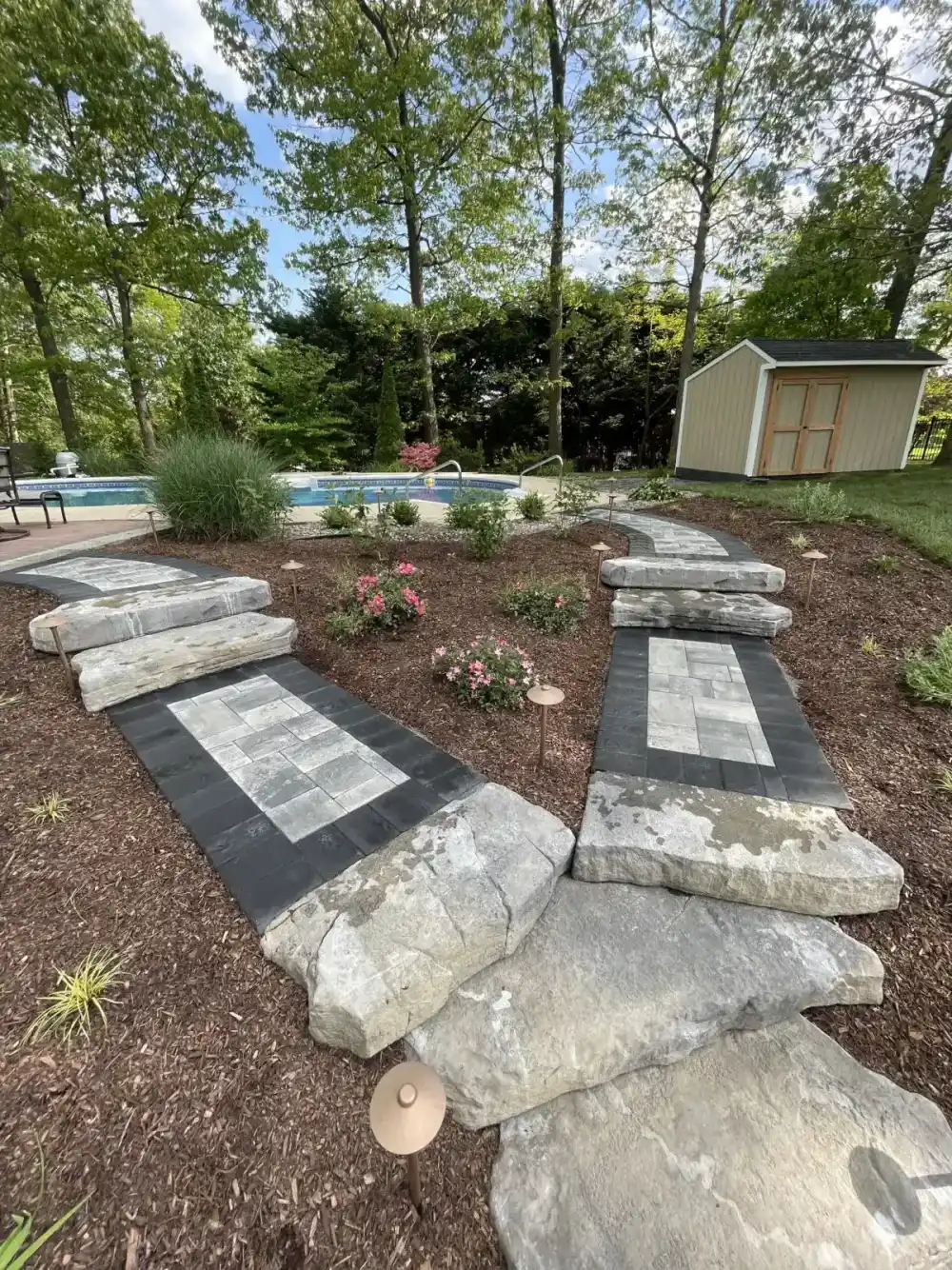
On a large property, hardscaping serves as the connective tissue between the home and its outdoor spaces. Walkways, terraces, retaining walls, and steps guide movement across the property while establishing a material vocabulary that ties everything together. The stone or paver you select for the front walkway should relate to the material on the rear terrace, the pool surround, and the garden paths, even if those elements are hundreds of feet apart.
For estate properties in South Jersey, natural stone is the preferred material. Pennsylvania bluestone, full-color flagstone, and thermal-finished granite provide the weight and permanence that large properties demand. These materials weather beautifully over decades, developing a patina that manufactured pavers cannot replicate. A bluestone terrace installed today will look better in ten years than it does on day one.
Retaining walls on estate properties often serve both structural and aesthetic purposes. A three-foot fieldstone wall that manages a grade change also creates a planting shelf, a seating ledge, and a visual boundary between the formal garden and the open lawn beyond. On properties with significant elevation changes, which are common on Gloucester County's rolling terrain, a series of terraced walls can transform an unusable hillside into a cascading garden with multiple levels of usable outdoor space.
Water Features as Focal Points
Water introduces an element that no other landscape feature can replicate: sound, reflection, and movement. On estate properties, water features are designed as destination elements, places where the eye is drawn and where people naturally gather. A natural stone waterfall cascading into a recirculating stream. A formal reflecting pool centered on an axis with the home's rear facade. A tiered fountain at the terminus of a walkway. Each of these creates a sensory experience that elevates the property from attractive to memorable.
The key to water features on large properties is proportional scale. A small bubbling rock might work on a quarter-acre lot, but it disappears on a two-acre estate. Estate water features need mass and presence. A waterfall installation using native Pennsylvania fieldstone, with a six to eight foot drop and a collecting pool at the base, creates the kind of visual and auditory impact that matches the scale of the property. These installations typically require a dedicated pump system, a buried basin or lined pond, and careful attention to water circulation to prevent stagnation.
For outdoor living areas, reflecting pools and fountain features work particularly well as centerpieces for formal gardens or courtyard spaces. A rectangular reflecting pool edged in bluestone, positioned to mirror the home's architecture, creates a sense of refinement that plants alone cannot achieve. In South Jersey's climate, all water features require winterization protocols, including draining pumps and exposed plumbing before the first hard freeze, which typically arrives in late November.
Ready to Transform Your Property?
Contact Miller's Landscaping for a complimentary on-site consultation. We will walk your property, discuss your vision, and develop a master plan tailored to your estate.
Get a Free EstimateDrainage Engineering for Large Properties
Drainage is the least glamorous component of estate landscaping and the most consequential. On properties exceeding one acre, stormwater management is not optional. It is an engineering requirement. Gloucester County's clay-heavy soils drain poorly under the best conditions, and a heavy summer storm can dump two inches of rain in an hour. Without a comprehensive drainage plan, that water pools against foundations, erodes planting beds, saturates lawns, and undermines hardscape installations.
Estate drainage systems typically combine multiple strategies. French drains, perforated pipe buried in gravel trenches, intercept subsurface water before it reaches foundations and hardscape areas. Surface grading directs sheet flow away from structures and toward designated collection points. Channel drains along driveways and patios capture concentrated runoff. And rain gardens, planted depressions designed to absorb and filter stormwater, handle overflow while adding visual interest to the landscape.
On larger properties, we often design dry creek beds that double as drainage corridors and landscape features. A naturalistic stream bed lined with river rock and bordered by native ferns, sedges, and cardinal flower carries stormwater during rain events and reads as an attractive garden element during dry periods. This approach is particularly effective on properties with natural swales or low areas that already collect water seasonally.
Designing for Four-Season Interest
South Jersey's Zone 7a climate offers a genuine four-season landscape experience, which means an estate planting plan should deliver visual interest twelve months a year. Too many residential landscapes peak in June and look barren by December. Estate-quality design deliberately sequences interest across all four seasons.
Spring opens with flowering trees: yoshino cherry, dogwood, redbud, and magnolia. These are followed by azaleas, rhododendrons, and early perennials like bleeding heart and hellebore. Summer brings the full display, hydrangeas in multiple varieties, daylily drifts, ornamental grasses reaching full height, and the deep green canopy of mature shade trees. Fall is where South Jersey truly excels. Red maples, sweetgum, and oak species produce intense foliage color from mid-October through November, and ornamental grasses like miscanthus and switchgrass turn gold and bronze.
Winter interest is the hallmark of thoughtful estate design. Evergreen structure from holly, boxwood, arborvitae, and spruce provides the framework that prevents the property from looking empty. Red and yellow twig dogwood add color to otherwise dormant borders. The bark of river birch and crape myrtle stands out against snow. And ornamental grasses, left standing through winter, catch frost and snow in ways that create genuinely striking compositions on cold mornings.
Irrigation Systems for Large Properties
An estate landscape without professional irrigation is an estate landscape that will underperform. Large properties with diverse planting zones, lawns, perennial beds, specimen trees, and container plantings each have different water requirements that cannot be met by dragging hoses across two acres. A professional-grade irrigation system designed for an estate property uses zoned delivery to match water volume and frequency to each area's specific needs.
Smart controllers are standard on estate installations. These systems connect to local weather stations and adjust watering schedules automatically based on rainfall, temperature, humidity, and wind conditions. During South Jersey's rainy spring months, the system scales back. During August dry spells, it increases run times. Over the course of a season, a properly programmed smart controller reduces water usage by 30 to 50 percent compared to a fixed-timer system.
Drip irrigation zones are essential for foundation plantings, perennial borders, and specimen tree root zones. Drip delivers water directly to the root zone at slow rates, eliminating waste from evaporation and overspray. Rotary nozzle heads cover large lawn areas efficiently, and matched precipitation rate design ensures that every zone delivers water evenly, eliminating dry spots and soggy patches. For properties on well water, which is common in rural areas of Gloucester and Salem counties, the system must be designed around the well's recovery rate to avoid running the pump dry.
Establishing a Maintenance Program From Day One
An estate landscape is a living system, and it requires professional stewardship from the moment it is installed. The most common mistake property owners make is investing $100,000 or more in a landscape installation and then handing maintenance to a mow-and-blow crew. Within two seasons, specimen plantings are improperly pruned, ornamental grasses are cut at the wrong time, irrigation heads are damaged by mowers, and the property's designed character begins to degrade.
A proper landscape maintenance program for an estate property includes seasonal pruning schedules calibrated to each species, fertilization programs based on annual soil testing, irrigation system startup in spring and winterization in fall, mulch renewal, weed management in planting beds, pest and disease monitoring, and seasonal color rotations for high-visibility areas. This is not a monthly visit. Estate maintenance operates on weekly or biweekly cycles, with additional seasonal task days for major operations like fall cleanup and spring bed preparation.
We recommend building the maintenance program into the master plan from the design phase. Knowing how a property will be maintained influences plant selection, bed layout, mulch choices, and even irrigation design. A low-maintenance native meadow requires different care than a formal boxwood parterre, and both can coexist on the same property when planned intentionally.
Investment Ranges for Estate Landscaping
Estate landscaping is a significant investment, and transparency about costs helps property owners plan effectively. In South Jersey, comprehensive estate landscaping projects generally fall into two tiers.
For properties seeking a full-landscape transformation including master planning, foundation plantings with specimen trees, hardscape walkways and a terrace, a drainage system, professional irrigation, and landscape lighting, expect to invest $50,000 to $150,000. This covers properties in the one to two acre range with moderate grading and standard access conditions. The exact figure depends on plant sizes, stone selection, and the extent of hardscape coverage.
For complete property transformations that include all of the above plus water features, pool integration, outdoor kitchen or living pavilion, extensive retaining wall systems, driveway redesign, and perimeter screening, investment ranges from $150,000 to $500,000 or more. These projects typically phase over two to three construction seasons, allowing the landscape to establish between phases and giving the property owner time to evaluate each completed section before committing to the next.
In both cases, the return on investment is substantial. According to the National Association of Realtors, professional landscaping adds 10 to 15 percent to a property's appraised value. On a $1 million home, that translates to $100,000 to $150,000 in added equity, often exceeding the cost of the landscaping itself. Beyond financial returns, the daily experience of living on a thoughtfully designed property is something that appreciates in ways no spreadsheet captures.
The Miller's Landscaping Approach to Estate Projects
Estate landscaping demands a contractor who operates as a design-build firm, not a crew that shows up with a truck full of plants and a rough sketch. At Miller's Landscaping, we manage every phase of the process in-house: site analysis, master planning, grading and drainage engineering, hardscape construction, planting installation, irrigation, lighting, and ongoing maintenance. There is one point of contact, one team responsible for the outcome, and one standard of quality across every element of the project.
We have been designing and building high-end landscapes across Gloucester, Camden, Salem, Atlantic, Cape May, and Cumberland counties for over seven years. Our estate clients value the fact that the same team that sets a specimen tree with a crane also returns monthly to monitor its establishment. That continuity of care is what ensures a landscape investment performs as intended, not just on installation day, but for decades to come.
Discuss Your Estate Landscape Vision
Contact Miller's Landscaping for a complimentary on-site consultation. We will assess your property, listen to your goals, and outline a master plan approach with transparent pricing.
Get a Free Estimate